
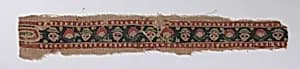
Fragment of a Shoulder Band
Unknown Artist
5th century
Medium
Wool, linen; plain weave, tapestry weave
Dimensions
Max. H. 2 5/16 in. (5.8 cm) Max. W. 15 7/8 in. (40.4 cm)
Classification
Textiles
Department
Islamic Art
Museum
Metropolitan Museum of Art, New York, NY
Credit
Gift of George F. Baker, 1890
Accession Number
90.5.350
Rights
Public Domain
Art Historical Context
This delicate fragment of a shoulder band, dating to the 5th, offers a rare glimpse into early textile artistry from the Islamic world. Likely part of a garment such as a tunic, it would have adorned the shoulder, signifying status or cultural identity in daily life or ceremonies. Housed in the Metropolitan Museum of Art's Islamic Department, this piece—measuring just 2 5/16 inches high and 15 7/8 inches wide—was generously gifted by George F. Baker in 1890, preserving a fragile artifact from antiquity. Crafted from wool and linen using plain weave for the sturdy ground fabric and tapestry weave for vibrant decoration, the band exemplifies sophisticated weaving techniques prevalent in the Near East and Egypt during late antiquity. Tapestry weave, where colored weft threads create pictorial or geometric motifs without a visible ground, allowed for bold patterns despite the medium's perishability—textiles like this rarely survive due to climate and use. Its cultural significance lies in bridging pre-Islamic and early Islamic traditions, highlighting the enduring skill of anonymous artisans. Such fragments reveal how everyday materials transformed into symbols of beauty and heritage, inviting us to imagine the hands that wove them over 1,500 years ago.