
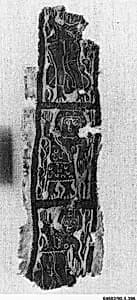
Fragment of a Shoulder Band
Unknown Artist
4th–5th century
Medium
Wool, linen; plain weave, tapestry weave
Dimensions
Max. H. 9 1/4 in. (23.5 cm) Max. W. 2 1/2 in. (6.4 cm)
Classification
Textiles
Department
Islamic Art
Museum
Metropolitan Museum of Art, New York, NY
Credit
Gift of George F. Baker, 1890
Accession Number
90.5.396
Rights
Public Domain
Art Historical Context
This delicate fragment of a shoulder band, dating to the 4th–5th century, offers a glimpse into the sophisticated textile traditions preserved in the Metropolitan Museum of Art's Islamic Art. Measuring just 9¼ inches high and 2½ inches wide, this narrow strip—likely part of a garment's decorative edging—was crafted from wool and linen using plain weave for the foundation and tapestry weave for intricate patterns. Such techniques highlight the skill of ancient weavers, who combined durability with ornamental flair, often adorning tunics or robes worn by everyday people or elites. In the context of early Islamic art, this piece reflects the rich weaving heritage of the Near East and Egypt, where textiles served as both functional clothing and symbols of cultural identity. The use of tapestry weave allowed for vibrant motifs—though faded here—possibly geometric or figurative designs that influenced later Islamic patterns. Donated in 1890 by George F. Baker, it underscores the Met's commitment to preserving these fragile artifacts, which rarely survive due to their organic materials. Though small, this shoulder band fragment reveals the artistry of pre-Islamic and early Islamic societies, where handwoven textiles were prized commodities traded across regions, blending utility with aesthetic beauty.