
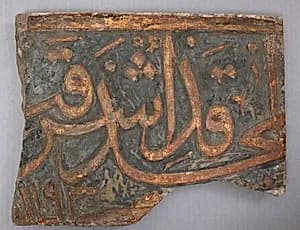
Fragment of an Inscribed Frieze
Unknown Artist
18th century
Medium
Marble
Dimensions
H. 11 1/4 in. (28.6 cm) W. 14 1/2 in. (36.8 cm)
Classification
Sculpture
Department
Islamic Art
Museum
Metropolitan Museum of Art, New York, NY
Credit
Museum Accession
Accession Number
x.362
Rights
Public Domain
Tags
Art Historical Context
This exquisite *Fragment of an Inscribedieze*, carved from marble in the 18th, offers a glimpse into the splendor of Islamic architectural decoration. Measuring just 11¼ inches high and 14½ inches wide, this sculpted piece likely originated from a larger frieze adorning a mosque, palace, or madrasa, where such elements framed doorways, arches, or walls to enhance sacred or royal spaces. Its presence in the Metropolitan Museum of's Islamic Art department highlights enduring allure of these artifacts, preserved as a testament to masterful stonework from a vibrant era. At the heart of the frieze's beauty is its intricate calligraphy, a hallmark of Islamic art where written words—often Qur'anic verses, poetry, or invocations—served as both decoration and devotion. Unlike figural imagery, which was often avoided in religious contexts, calligraphy elevated language to an artistic form, with fluid scripts like thuluth or naskh carved with precision into durable marble. This technique demanded exceptional skill, as sculptors balanced depth, shadow, and rhythm to make inscriptions legible and mesmerizing from afar. Though the artist remains unknown, the fragment embodies the cultural sophistication of 18th-century Islamic civilizations, from the Ottoman Empire to Safavid Persia, where architecture fused faith, aesthetics, and patronage. Visitors are invited to trace the elegant curves, imagining them alive under lantern light in a bustling historic city.