
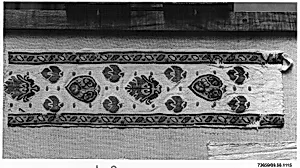
Fragment of an Ornamented Band
Unknown Artist
7th–10th century
Medium
Linen, wool; tapestry weave
Dimensions
H. 14 1/4 in. (36.2 cm) W. 4 1/4 in. (10.8 cm)
Classification
Textiles
Department
Islamic Art
Museum
Metropolitan Museum of Art, New York, NY
Credit
Rogers Fund, 1909
Accession Number
09.50.1115
Rights
Public Domain
Art Historical Context
This delicate *Fragment of an Ornamented Band*, dating to the 7th–10th century, offers a glimpse into the refined world of early Islamic textiles. Crafted from linen and wool tapestry weave—a technique where colorful weft threads fully cover the warp to create vibrant, intricate patterns—this narrow band (14¼ × 4¼ in.) likely adorned clothing, furnishings, or ceremonial objects. Housed in the Metropolitan Museum of Art's Islamic Department, it entered the collection through the Rogers Fund in 9. Tapestry weave was a hallmark of Islamic textile production, prized for its durability and ability to render complex motifs without loose threads. During this formative period of Islamic civilization, such fragments often originated from regions like Egypt, where weaving workshops thrived amid cultural exchanges between Byzantine, Coptic, and emerging Islamic traditions. The unknown artisan's skill highlights the anonymous mastery behind everyday luxuries. As a survivor of time, this fragment underscores textiles' role in Islamic art: portable, precious commodities that spread artistic ideas along trade routes. Its preservation invites us to imagine the hands that wove it, weaving stories of faith, beauty, and craftsmanship into the fabric of history.