
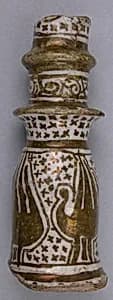
Fragment of Bottle
Unknown Artist
10th century
Medium
Earthenware; luster-painted
Classification
Ceramics
Department
Islamic Art
Museum
Metropolitan Museum of Art, New York, NY
Credit
Rogers Fund, 1966
Accession Number
66.95.2
Rights
Public Domain
Art Historical Context
This exquisite *Fragment of Bottle* from the 10th century a glimpse into the golden age of Islamic ceramics during the Abbasid era. Crafted from earthenware and adorned with luster-painting, it hails from a time when artisans in regions like Iraq and Persia pushed the boundaries of pottery decoration. As part of the Metropolitan Museum of Art's Islamic Art collection, acquired through the Rogers Fund in 1966, this shard captures the ingenuity of anonymous craftsmen who transformed humble clay into shimmering treasures. Luster-painting, a hallmark technique of Islamic pottery, involved applying metallic oxides—typically copper and silver—to a glazed surface, then firing it in a reduced-oxygen kiln to create an iridescent, gold-like sheen. This innovation, perfected around the 9th century, allowed potters to rival costly metalwork and glass, making luxury accessible. The fragment likely once formed part of a bottle used for perfumes, oils, or storage, its surface probably featuring intricate geometric or floral motifs symbolic of paradise gardens in Islamic culture. Though incomplete, this piece highlights the cultural exchange along Silk Road trade routes, blending technical mastery with aesthetic elegance. It reminds us how 10th-century Islamic artists elevated everyday objects into art, influencing ceramics across the Mediterranean and beyond. (198 words)