
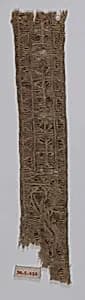
Fragment of Shoulder Band
Unknown Artist
5th century
Medium
Wool, linen; plain weave, tapestry weave
Dimensions
Max. H. 8 7/8 in. (22.5 cm) Max. W. 1 7/16 in. (3.7 cm)
Classification
Textiles
Department
Islamic Art
Museum
Metropolitan Museum of Art, New York, NY
Credit
Gift of George F. Baker, 1890
Accession Number
90.5.450
Rights
Public Domain
Art Historical Context
This delicate *Fragment of Shoulder Band* the 5th century a glimpse into the sophisticated textile traditions of the early Islamic world. Crafted wool and linen using plain weave for the foundation and tapestry weave for decorative accents, this narrow strip—measuring just 8 7/8 inches high 1 7/16 inches wide—was likely part a garment's shoulder decoration. Such bands adorned clothing for both everyday wear and special occasions, showcasing the weavers' mastery in blending durability with ornamentation. Textile production in this era was a labor-intensive art form, vital to trade and cultural exchange across the Islamic realms. The combination of plain and tapestry weaves highlights technical innovation: plain weave provided a sturdy base, while tapestry allowed for vibrant, pictorial inserts—though faded here, they once featured motifs reflecting daily life or symbolism. Surviving fragments like this are rare, preserving evidence of pre-Islamic influences blending into emerging Islamic aesthetics. A generous gift to the Metropolitan Museum of Art from George F. Baker in 1890, this piece invites us to appreciate the unsung artisans whose threads wove the fabric of history. In the Islamic Art galleries, it reminds visitors of textiles' role as portable treasures, carrying stories across centuries.