
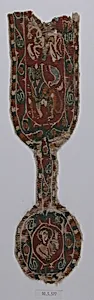
Fragment of Shoulder Band
Unknown Artist
6th–7th century
Medium
Wool, linen; tapestry weave
Dimensions
Max. H. 14 9/16 in. (37 cm) Mas. W. 3 11/16 in. (9.4 cm)
Classification
Textiles
Department
Islamic Art
Museum
Metropolitan Museum of Art, New York, NY
Credit
Gift of George F. Baker, 1890
Accession Number
90.5.577
Rights
Public Domain
Art Historical Context
This delicate *Fragment of Band*, dating to the 6th–7th century, offers a glimpse into the textile artistry of the early Islamic world. Likely part of a garment's decorative shoulder trim, this narrow wool and linen strip measures just 14 9/16 inches high and 3 11/16 inches wide. Preserved in the Metropolitan Museum Art's Islamic Art Department, it entered the collection in 1890 as a gift from George F. Baker highlighting the museum's early commitment to Middle Eastern artifacts. Crafted in tapestry weave—a technique where colored weft threads are woven back and forth to form motifs without supplementary yarns—this fragment exemplifies the sophisticated weaving skills of the era. Tapestry weaves were prized for their durability and ability to create vibrant, pictorial designs, often adorning clothing, tunics, or liturgical vestments. In the transitional 6th–7th century context, such textiles bridged late antique traditions (like Coptic or Sasanian influences) with emerging Islamic aesthetics, where fabric served both practical and symbolic roles in daily life and trade across the Mediterranean and Near East. Though incomplete, this piece underscores the cultural centrality of textiles in early Islamic societies, where weaving was a revered craft reflecting regional prosperity and artistic innovation. A quiet survivor of time, it invites us to imagine the hands that wove it and the shoulders it once adorned.