
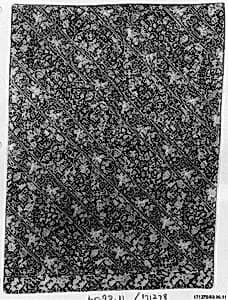
Fragment of Woman's Trousering (Nakshe)
Unknown Artist
18th century
Medium
Silk; embroidered
Dimensions
H. 22 7/8 in. (58.1 cm) W. 16 7/8 in. (42.8 cm)
Classification
Textiles-Embroidered
Department
Islamic Art
Museum
Metropolitan Museum of Art, New York, NY
Credit
Anonymous Gift, 1960
Accession Number
60.98.11
Rights
Public Domain
Art Historical Context
This exquisite fragment of woman's trousering, known as *Nakshe*, hails from the 18th century and exemplifies the refined artistry of Islamic textile traditions. Crafted from luxurious silk and richly embroidered, it measures 22 7/8 by 16 7/8 inches (58.1 x 42.8 cm), preserving a portion of what was once a flowing garment for women's lower body. Displayed in the Metropolitan Museum of Art's Department of Islamic Art, this piece—acquired through an anonymous gift in 0—offers a glimpse into the opulent world of period fashion, where silk's sheen and intricate needlework signaled status and sophistication. In Islamic cultures of the 18th century, embroidered textiles like this were prized for their technical mastery and aesthetic harmony. The embroidery technique, applied directly to silk, likely featured motifs drawn from nature or geometry—hallmarks of the era's decorative arts—demonstrating skilled labor that could take months. Women's trousering, or *shalwar*, was essential attire across regions from Persia to Central Asia, blending functionality with beauty in everyday life. As a rare survivor, this fragment highlights the fragility of textiles and their cultural role in storytelling through fabric. Visitors can appreciate how such works bridged utility and art, inviting us to imagine the women who wore them centuries ago.