
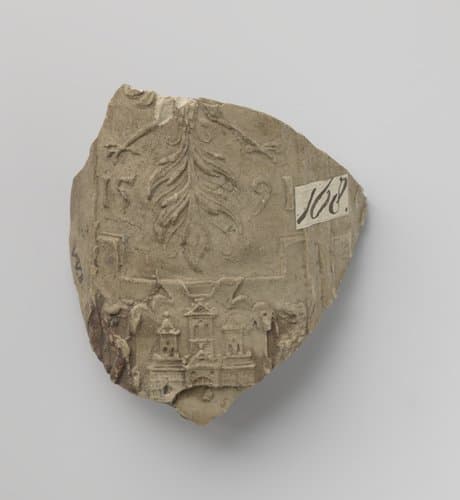
Fragment van een kruik (schnelle) met een wapen
c. 1591 - c. 1610
Medium
turning
Dimensions
3.8; 6.5; 6.7
Rights
Public Domain
About this artwork
Gedeelte van de buik van een snel van steengoed. Versierd met de voorstelling van een arend, waaronder een burcht en het jaartal 1591.
Art Historical Context
This delicate fragment hails from the belly of aschnelle*—a distinctive type of stoneware jug popular in the late 16th and early 17th centuries.ed anonymously around 1591–1610, it measures just 3.8 cm high by 6.7 cm wide and 6.5 cm deep, showcasing the everyday artistry of Rhineland potters. Made using the wheel-throwing technique (known as *draaien* in Dutch), the piece exemplifies stoneware's durability and fine craftsmanship, likely salt-glazed for a smooth, glossy finish that made these jugs prized for tableware across Europe. The decoration steals the show: a bold eagle perches above a sturdy castle (*burcht*), accompanied by the inscribed date 1591. The eagle and castle likely form a heraldic emblem or *wapen* (coat of arms), personalizing the jug for a patron or marking its origin—common on *schnelle* wares from workshops in Raeren or Westerwald. These motifs symbolized strength and nobility, blending functionality with symbolic flair. As a snapshot of proto-industrial pottery, this fragment highlights how anonymous artisans elevated humble vessels into cultural artifacts. Exported widely during a time of trade boom, such jugs bridged households and history, offering a tangible link to Renaissance daily life.
About the Artist
anonymous
In the vast tapestry of art history, "Anonymous" stands not as a singular individual but as a collective designation for countless unidentified creators whose works have endured across millennia. These artists, spanning prehistoric cave painters to medieval illuminators and folk craftsmen, produced the foundational layers of human visual culture. Prior to the Renaissance, when individual fame emer...