
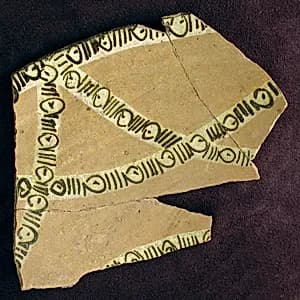
Fragment with Pseudo-Calligraphic Bands
Unknown Artist
late 10th–early 11th century
Medium
Earthenware; polychrome decoration under transparent glaze
Dimensions
H. 7 3/16 in. (18.2 cm) W. 4 13/16 in. (12.2 cm)
Classification
Ceramics
Department
Islamic Art
Museum
Metropolitan Museum of Art, New York, NY
Credit
Rogers Fund, 1940
Accession Number
40.170.528
Rights
Public Domain
Art Historical Context
This enchanting fragment, hailing from the late th to early 11th century offers a glimpse into the vibrant of Islamic ceramics. Crafted by an unknown artist, it exemplifies earthenware adorned with polychrome decoration under transparent glaze—a technique that brought bold colors and luminosity to everyday and ceremonial objects in the Islamic world. Likely part of a larger vessel, modest dimensions (about 7 by 5 inches) belie its intricate design, preserved today in the Metropolitan Museum of's Islamic Art Department through the Rogers Fund of 1940. The standout feature is the "pseudo-calligraphic bands," rhythmic patterns mimicking the flowing lines of Kufic script, a hallmark of early Islamic decoration. These non-readable motifs evoke the reverence for calligraphy in Islamic culture while serving pure aesthetic delight, avoiding literal text to focus on visual harmony. The polychrome palette—vibrant slips fired beneath a glossy transparent glaze—created durable, jewel-like effects, influencing ceramics across regions from Egypt to Persia. For visitors, this fragment highlights a pivotal era when Islamic potters pioneered glazed wares, blending functionality with artistry. It invites reflection on how abstract patterns bridged the sacred and the decorative, a legacy that resonates in museum galleries today.