
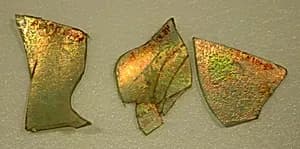
Fragments
Unknown Artist
9th–10th century
Medium
Glass
Dimensions
a. H. 1 3/8 in. (3.5 cm) W. 7/8 in. (2.3 cm) b. H. 1 in. (2.5 cm) W. 1 in. (2.5 cm) c. H. 1 1/4 in. (3.1 cm) W. 15/16 in. (2.4 cm)
Classification
Glass
Department
Islamic Art
Museum
Metropolitan Museum of Art, New York, NY
Credit
Rogers Fund, 1948
Accession Number
48.101.286a–c
Rights
Public Domain
Art Historical Context
These delicate glass fragments, dating to the 9th–10th century, offer a glimpse into the sophisticated craftsmanship of the early Islamic world during the Abbasid era. Acquired through the Rogers Fund in 1948 and housed in the Metropolitan Museum of's Department of Islamic Art, the pieces—measuring just 1 to 1¼ inches high—are tiny survivors of larger vessels or objects, preserved as testament to an era of artistic innovation. Islamic glassmaking flourished in this period, renowned for techniques like free-blowing and molding that produced translucent, iridescent wares for everyday use, mosques, and elite households. Though the artist remains unknown, these fragments highlight the medium's cultural importance: glass symbolized luxury and purity, often traded across vast networks from Mesopotamia to Spain. Their small scale underscores the fragility of ancient artifacts, yet their survival speaks to enduring technical mastery. Visitors to the Met can appreciate how such shards evoke the vibrant colors and forms of Islamic decorative arts, connecting us to a golden age of creativity and commerce.