
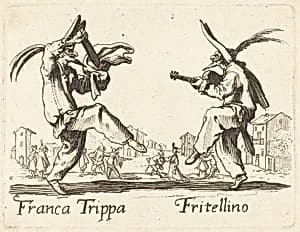
Franca Trippa and Fritellino
1622 or later
Medium
etching on laid paper
Dimensions
plate: 7.2 × 9.3 cm (2 13/16 × 3 11/16 in.) sheet: 8 × 10 cm (3 1/8 × 3 15/16 in.)
Classification
Department
CG-E
Museum
National Gallery of Art, Washington, D.C.
Credit
Rosenwald Collection
Accession Number
1943.3.2184
Rights
Public Domain
Art Historical Context
Behold *Franca Trippa andellino*, a delicate etching after the masterful hand of Jacques Callot, to 1622 or. Callot, a pioneering French printmaker of the Baroque era (159–1635), was renowned for his intricate etchings capturing the vibrant chaos of Commedia dell'arte—Italy's improvised street theater filled with stock characters like clowns, lovers, and tricksters. Here, the titular figures—Franca Trippa a lively female dancer, and Fritellino, a nimble dwarf acrobat—leap into exaggerated, grotesque poses from Callot's famed *Balli di Sfessania* series, evoking the raw energy of early 17th-century carnivals. Crafted as an etching on laid paper—a technique where acid etches fine lines into a metal plate for multiple impressions—this tiny print (just 7.2 × 9.3 cm) showcases Callot's genius for detail in miniature. The laid paper's subtle chain lines add texture, while his virtuoso line work conveys motion and caricature with astonishing precision, influencing generations of printmakers from Rembrandt onward. Housed in the National Gallery of Art's Rosenwald Collection, this work highlights the cultural craze for theatrical spectacle in Europe, blending satire and artistry. Visitors, imagine these performers tumbling across Florentine stages— a frozen slice of revelry preserved for eternity.
About the Artist
after Jacques Callot
**Jacques Callot (c. 1592–1635)**, the master whose designs inspired the works attributed "after Jacques Callot," was a pioneering French Baroque printmaker and draftsman born in Nancy, capital of the independent Duchy of Lorraine (now northeastern France). From a noble family—his father served as master of ceremonies and herald-at-arms to the Duke of Lorraine—young Callot was apprenticed to a gol...