
Francesco IV Gonzaga, Duke of Mantua (1586–1612)
1612
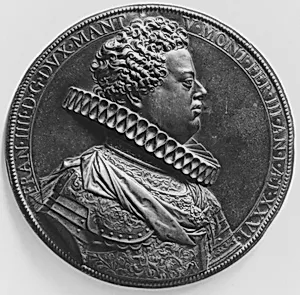
Medium
Bronze, brown patina
Dimensions
Diam. 6 1/2 in. (165 mm.)
Classification
Medals and Plaquettes
Culture
French
Department
European Sculpture and Decorative Arts
Museum
Metropolitan Museum of Art, New York, NY
Credit
Harris Brisbane Dick Fund, 1936
Accession Number
36.110.31
Rights
Public Domain
Tags
Art Historical Context
This bronze medal, created by the French medallist Guillaume Dupré in 1612, portrays Francesco IV Gonzaga, the short-lived Duke of Mantua and Montferrat. Rendered in profile with a dignified bearing, the young ruler appears in contemporary attire, his features captured with remarkable realism. Dupré, active at the French court under Henry IV, specialized in such portrait medals, drawing on Italian Renaissance traditions to blend sculptural depth with numismatic precision. Measuring just over six inches in diameter, the work exemplifies the bronze medal’s role as both art object and political instrument. Cast with a rich brown patina, it commemorates Francesco’s brief reign, which ended with his death at age twenty-six. Such medals were often produced to mark significant events or preserve the likeness of rulers for diplomatic exchange and posterity. Dupré’s sensitive modeling of the duke’s youthful face and the careful lettering of the inscription reflect the high technical standards of early seventeenth-century French medallic art. Today, the piece offers visitors a tangible connection to the Gonzaga dynasty and the sophisticated visual language of power in Baroque Europe.
About the Artist
Guillaume Dupré · 1579–1640
**Guillaume Dupré (1579–1640)** Guillaume Dupré, born in Sissonne near Laon, emerged as one of France's premier sculptors and medallists during the transition from Renaissance to Baroque art. He studied under the renowned sculptor Barthélemy Prieur, marrying Prieur's daughter Madeleine in 1600 and later fathering Abraham Dupré, who followed in his footsteps as a medallist. His early talent caught...