
Francesco
Medium
engraving on laid paper
Dimensions
sheet (trimmed to plate mark): 13.2 × 8.3 cm (5 3/16 × 3 1/4 in.)
Classification
Department
CG-E
Museum
National Gallery of Art, Washington, D.C.
Credit
R.L. Baumfeld Collection
Accession Number
1969.15.332
Rights
Public Domain
Art Historical Context
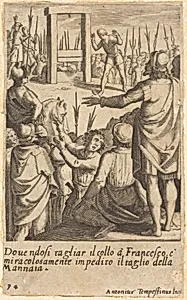
Discover the intricate engraving *Francesco* (1619), a masterful reproduction by French artist Jacques Callot after an original design by Italian painter Antonio Temp. Measuring just 13.2 × 8.3 cm, this small-scale print on laid paper exemplifies the exquisite detail achievable in early 17th printmaking. Housed in the National Gallery of Art's R. Baumfeld Collection ( CG-E), it captures Callot's emerging prowess during his time in Florence under Medici patronage. Callot, a pioneer of the Baroque etching and engraving techniques, was renowned for his precise line work and ability to convey movement and narrative in miniature formats. Here, he interprets Tempesta's composition—likely evoking equestrian or historical themes common to the artist's oeuvre—using burin-engraved lines on a copper plate, inked and pressed onto laid paper with its characteristic chain lines and watermarks. This reproductive print highlights the era's booming print market, making high-art designs accessible to collectors across Europe amid the stylistic shift from Mannerism to Baroque dynamism. Culturally, *Francesco* reflects 1619's vibrant exchange between Italian and Northern European artists, bridging Tempesta's dramatic animal and battle scenes with Callot's innovative clarity. Its trimmed sheet preserves the plate's edge, inviting close inspection of Callot's virtuoso technique—a testament to prints as both art and dissemination tools in the pre-photographic age.