
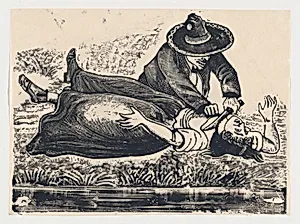
Francisco Guerrero, the waistcoat maker and cut throat, murdering a woman
ca. 1905–1910
Medium
Type-metal engraving
Dimensions
Sheet: 5 5/16 × 7 5/16 in. (13.5 × 18.5 cm)
Classification
Prints
Department
Drawings and Prints
Museum
Metropolitan Museum of Art, New York, NY
Credit
Gift of Jean Charlot, 1930
Accession Number
30.82.21
Rights
Public Domain
Tags
Art Historical Context
José Guadalupe Posada, a pioneering Mexican printmaker active in the late 19th and early 20th centuries, this stark type-metal engraving around 1905–1910. Titled *Francisco Guerrero, the waist maker and cut throat, a woman*, the print depicts a gruesome crime scene, capturing the moment a man—likely based on a real notorious figure—attacks a victim. Posada's bold, black-and-white style, rendered on a modest sheet measuring just 5 5/16 × 7 5/16 inches, draws from the tradition of illustrated broadsheets or *corridos* that sensationalized news, crimes, and social ills for Mexico's working-class readers. Type-metal engraving, a relief printing technique Posada mastered using inexpensive metal plates, allowed for mass production on cheap paper, making his works accessible yet enduring. This medium underscores his role as a social commentator during the Porfiriato era, a time of political repression and inequality just before the Mexican Revolution. Themes of suffering, violence between men and women, and human brutality reflect the era's underbelly, where Posada often blurred lines between fact and folklore to critique society. Housed in the Metropolitan Museum of Art's Drawings and Prints department (gift of Jean Charlot, 1930), this piece exemplifies Posada's macabre realism and satirical edge, influencing later Mexican artists like Diego Rivera. It invites visitors to ponder how art can immortalize fleeting tragedies, turning personal horror into public memory.
About the Artist
José Guadalupe Posada · 1852–1913
José Guadalupe Posada (1852-1913) was a Mexican printmaker and engraver who revolutionized popular art and created some of the most iconic images in Mexican culture. Working primarily with publisher Antonio Vanegas Arroyo, he produced over 20,000 images during his career—inexpensive broadsheets sold for a penny on colored paper that made his art accessible to even the poorest workers. He transform...