
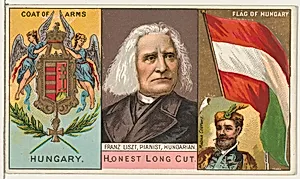
Franz Liszt, Pianist, Hungarian, from the Rulers, Flags, and Coats of Arms series (N126-1) issued by W. Duke, Sons & Co.
Medium
Commercial color lithograph
Dimensions
Sheet: 2 1/2 × 4 5/16 in. (6.4 × 11 cm)
Classification
Prints|Ephemera
Department
Drawings and Prints
Museum
Metropolitan Museum of Art, New York, NY
Credit
The Jefferson R. Burdick Collection, Gift of Jefferson R. Burdick
Accession Number
63.350.206.126.23
Rights
Public Domain
Tags
Art Historical Context
Step into the vibrant world of 19th-century ephemera with this charming commercial color lithograph from 1888, featuring Franz Liszt, the legendary Hungarian pianist and composer. Titled *Franz Liszt, Pian, Hungarian*, it hails from the *Rulers, Flags, Coats of Arms* (N126-1), blending portraiture with national symbols like flags and coats of arms. At just 2½ × 4⅜ inches, this petite print captures Liszt's profile, evoking his status as a Romantic-era superstar who dazzled audiences across Europe with his virtuosic performances. Issued by W. Duke, Sons & Co., a pioneering American tobacco firm, the card was likely tucked into cigarette packages as a collectible incentive—a clever marketing tactic that fueled the cigarette card craze. Produced via chromolithography, a technique mastering vibrant, multi-color printing on a mass scale, it exemplifies how commercial art democratized celebrity imagery. Liszt (1811–1886), who passed just two years prior, embodies the era's adoration for musical geniuses, rubbing shoulders here with world leaders and emblems of power. Today, housed in The Metropolitan Museum of Art's Jefferson R. Burdick Collection, this ephemera highlights the intersection of commerce, nationalism, and culture, reminding us how everyday tobacco inserts preserved icons like Liszt for posterity. A tiny window into Gilded Age collecting fervor!
About the Artist
W. Duke, Sons & Co. · 1870–1920
**W. Duke, Sons & Co.: Pioneers of Chromolithographic Trade Card Art** W. Duke, Sons & Co., an American tobacco manufacturer, emerged from the entrepreneurial vision of Washington Duke (1820–1905) and his sons in Durham, North Carolina. After the Civil War, Washington abandoned farming in 1874 to join his eldest son, Brodie L. Duke, in the burgeoning tobacco trade, establishing a factory that for...