
Friedrich Wilhelm III of Prussia (1770–1840, r. 1797–1840)
ca. 1815
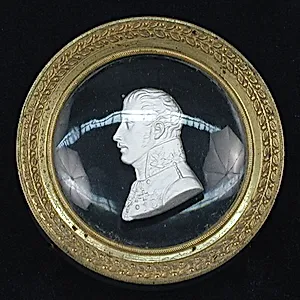
Medium
Glass, biscuit porcelain; gilded copper
Dimensions
Diameter: 2 3/4 in. (7 cm)
Classification
Glass
Culture
French, Paris
Department
European Sculpture and Decorative Arts
Museum
Metropolitan Museum of Art, New York, NY
Credit
Munsey Fund, 1927
Accession Number
27.185.381
Rights
Public Domain
Tags
Art Historical Context
This exquisite medallion, titled *Friedrich Wilhelm III of Prussia (1770–1840, r. 1797–1840)*, is a finely crafted profile portrait created by the French artist Désprez around 1815 in Paris. Measuring just 2¾ inches in diameter, it the delicate artistry of early 19th-century European decorative objects, blending glass and biscuit—unglazed, matte porcelain prized for its soft, ivory-like finish—with gilded copper accents. Housed in the Metropolitan Museum of Art's European and Decorative Arts Department it reflects the neoclassical taste for classical profiles and cameos popular during the Napoleonic era. Created amid the shifting alliances of the Napoleonic Wars, the piece immortalizes Prussia's King Friedrich Wilhelm III, who ruled from 1797 to 1840 and played a key role in the coalition against Napoleon, culminating in victories like Waterloo in 1815. French artisans like Désprez often produced such regal portraits for collectors, showcasing technical prowess in layering translucent glass over porcelain to achieve depth and lifelike modeling in the king's dignified profile. Its small scale suggests it may have adorned jewelry, snuffboxes, or tabletops, highlighting the era's fusion of portraiture with luxury crafts. A testament to cross-cultural exchange, this work underscores Paris's dominance in fine glasswork, now preserved through the Munsey Fund since 1927.