
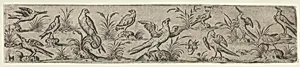
Frieze with Eleven Birds and an Insect
1590–1612
Medium
Engraving
Dimensions
Sheet: 1 1/2 × 7 3/8 in. (3.8 × 18.8 cm)
Classification
Ornament & Architecture|Prints
Department
Drawings and Prints
Museum
Metropolitan Museum of Art, New York, NY
Credit
Rogers Fund, 1917
Accession Number
17.79.8
Rights
Public Domain
Tags
Art Historical Context
Created by the Flemish engraver Jan Collaert I between 1590 and 1612, *Frieze with Eleven Birds and an Insect* exemplifies the ornamental print tradition that flourished in Northern Europe during the late Renaissance. Measuring just 1 ½ by 7 ⅜ inches, this delicate engraving was designed as a decorative border or pattern, likely intended for use by craftsmen working in architecture, furniture, or book ornamentation. Collaert’s precise line work captures the varied plumage and lively poses of the birds, demonstrating the high level of detail engraving could achieve even on a small scale. As part of the Metropolitan Museum’s collection of ornament and architecture prints, the work reflects the period’s growing interest in natural motifs drawn from the natural world. Birds and insects were popular subjects, symbolizing both the beauty of creation and the expanding scientific curiosity of the age. Such prints circulated widely among artists and artisans, allowing decorative designs to spread across Europe without the need for original paintings or sculptures. Visitors can appreciate how Collaert balanced naturalistic observation with the rhythmic, repeating structure required of a frieze. The result is both functional and charming, offering a glimpse into the everyday artistry that adorned homes and public spaces in the early modern period.