
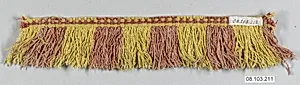
Fringe
Unknown Artist
18th century
Medium
Cotton
Dimensions
8 x 1 1/2 inches 20.3 x 3.8 cm
Classification
Textiles-Trimmings
Culture
Italian or Spanish
Department
European Sculpture and Decorative Arts
Museum
Metropolitan Museum of Art, New York, NY
Credit
Rogers Fund, 1908
Accession Number
08.103.211
Rights
Public Domain
Art Historical Context
Nestled in the Metropolitan Museum of Art's European Sculpture and Decorative collection, this delicate *Fringe* exemplifies the exquisite textile trimmings of 18th-century Italy or. Crafted from cotton and measuring just 8 x 1½ inches (20.3 x 3.8 cm), it was likely used to adorn garments, furnishings, or ecclesiastical vestments, adding a touch of elegance and movement to everyday luxury. In the Baroque and Rococo eras, such fringes were masterful displays of handcraftsmanship, often produced through intricate knotting, weaving, or bobbin techniques that created rhythmic patterns and tassel-like ends. Cotton, though more accessible than silk or gold thread, allowed for fine detail in these small-scale works, reflecting the period's blend of opulence and practicality across Mediterranean cultures. Acquired through the Rogers Fund in 1908, it highlights the Met's commitment to preserving these subtle yet significant artifacts of domestic and fashion history. Today, this unassuming trim invites us to appreciate the unsung artistry of textile makers, whose innovations influenced global design and continue to inspire modern couture and interiors.