
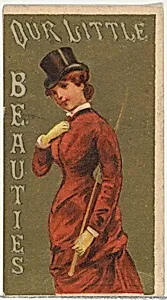
From the Girls and Children series (N58) promoting Our Little Beauties Cigarettes for Allen & Ginter brand tobacco products
1887
Medium
Commercial color lithograph
Dimensions
Sheet: 2 5/8 × 1 1/2 in. (6.7 × 3.8 cm)
Classification
Prints|Ephemera
Department
Drawings and Prints
Museum
Metropolitan Museum of Art, New York, NY
Credit
The Jefferson R. Burdick Collection, Gift of Jefferson R. Burdick
Accession Number
63.350.202.58.14
Rights
Public Domain
Tags
Art Historical Context
In the late 19th century, American tobacco companies like Allen & G revolutionized advertising with colorful insert cards tucked into cigarette packs. This commercial color lithograph, the 1887 "Girls and Children" series (N58), promotes "Our Little Beautiesarettes." Measuring just 2⅝ × 1½ inches, it exemplifies ephemera—everyday printed items now cherished for their historical snapshot. Allen & Ginter, pioneers in the trade card craze, produced millions of these vibrant cards to build brand loyalty and appeal to collectors. Chromolithography, the medium here, was a breakthrough technique blending multiple lithographic stones for rich, multi-hued prints affordable for mass production. This allowed intricate details in depictions of girls, evoking Victorian ideals of innocence and charm amid the era's booming consumer culture. Though tiny, these cards fueled a collecting frenzy, bridging art, commerce, and everyday life. Housed in the Metropolitan Museum of Art's Jefferson R. Burdick Collection, this piece highlights how tobacco marketing intertwined with popular imagery, offering a playful yet poignant glimpse into Gilded Age America—where childhood beauty sold smokes.
About the Artist
Allen & Ginter
Allen & Ginter, the pioneering American tobacco firm based in Richmond, Virginia, emerged around 1880 from the partnership of John F. Allen and Lewis Ginter, evolving from Allen's earlier John F. Allen & Company. Allen retired in 1882, succeeded by John Pope, yet the brand endured under Ginter's leadership, employing over 1,100 workers—mostly women—for hand-rolled cigarettes by 1886. Ginter, a Dut...