
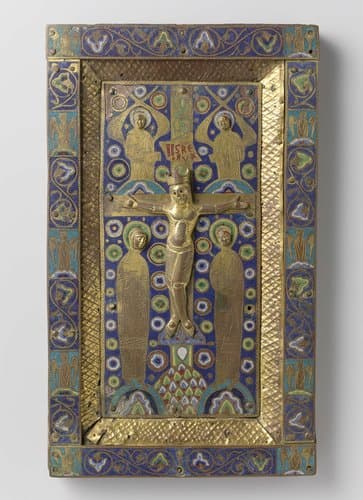
Front cover of an Evangeliary with the Crucifixion
ca. 1200 - ca. 1225
Medium
champlevé
Dimensions
2.5; 31.8; 19
Rights
Public Domain
About this artwork
…; collection St Antoniev monastery, Novgorod;{Note RMA; Von Falke 1936, p. 96, no. E.6.} …; collection Dr Fritz Mannheimer (1890-1939), Amsterdam and Paris, 1936;{Von Falke 1936, p. 96, no. E.6.} purchased from his estate, en bloc, by the Dienststelle Mühlmann, The Hague, for Adolf Hitler's Führermuseum, Linz, 1940;{Korthals Altes 1974, pp. 21-22.} war recuperation, SNK, 1945;{HNA, SNK Archive, 2.08.42, inv. no. 548.} on loan, with 1,702 other objects, from the DRVK to the museum, 1952;{Note RM...
Art Historical Context
This exquisite champlevé enamel front cover dating to around 1200–1225, once adorned an Evangeliary—a Gospel book used in liturgical services—from the St. Antoniev Monastery in Novgor, Russia. Measuring 31.8 cm high by 19 cm wide, it depicts the Crucifixion, a central motif in medieval Christian art, rendered with vivid colors and intricate details typical of Russian Orthodox metalwork from this era. Novgorod, a thriving medieval trade and cultural hub, produced such luxurious book bindings for ecclesiastical treasures, blending Byzantine influences with local craftsmanship. The champlevé technique—creating recessed cells in a copper or bronze base, then filling them with fired vitreous enamel—allowed for brilliant, durable colors that symbolized divine light and eternity. These covers elevated sacred texts, making them both functional and devotional artworks for monastic communities. Its journey adds poignant historical depth: from the monastery, it passed through collector Dr. Fritz Mannheimer's hands before being acquired in 1940 for Adolf Hitler's planned Führermuseum in Linz amid Nazi looting. Recuperated after World War II by Dutch authorities, it now resides in a museum collection, a testament to cultural resilience.
About the Artist
anonymous
In the vast tapestry of art history, "Anonymous" stands not as a singular individual but as a collective designation for countless unidentified creators whose works have endured across millennia. These artists, spanning prehistoric cave painters to medieval illuminators and folk craftsmen, produced the foundational layers of human visual culture. Prior to the Renaissance, when individual fame emer...