
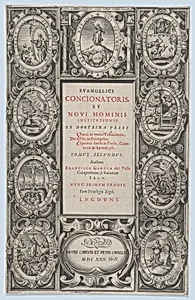
Frontispiece for Evangelicus Concionatoris, et Novi Hominis Institutionis
1622
Medium
Etching
Dimensions
Sheet (trimmed): 12 5/8 in. × 8 in. (32 × 20.3 cm)
Classification
Prints
Department
Drawings and Prints
Museum
Metropolitan Museum of Art, New York, NY
Credit
Gift of Henry W. Kent, 1941
Accession Number
41.44.1601
Rights
Public Domain
Tags
Art Historical Context
This etching by Charles Audran, created in 1622, serves as the frontispiece for the theological volume *Evangelicus Concionatoris, et Novi Hominis Institutionis*. As a print intended to introduce a work on evangelical preaching and spiritual formation, the image draws together key Christian symbols—Christ, the Crucifixion, saints, angels, and donkeys—to prepare the reader for themes of humility, sacrifice, and divine instruction. The donkey, in particular, evokes Christ’s entry into Jerusalem, linking everyday imagery with profound biblical narrative. Audran’s choice of etching allowed for fine linear detail and tonal depth, a technique well suited to the expanding world of illustrated religious books in the early seventeenth century. Produced as a single sheet measuring roughly 12 by 8 inches, the print was designed to be bound at the front of the volume, guiding the viewer’s contemplation before the text began. Now housed in the Metropolitan Museum of Art’s Department of Drawings and Prints, this work exemplifies how seventeenth-century artists used the reproducible medium of etching to disseminate devotional imagery across Europe. Its gift to the museum by Henry W. Kent in 1941 underscores the enduring value of such prints in preserving the visual culture of religious thought.