
Frontispiece, from Varie Figure (Various Figures)
ca. 1620
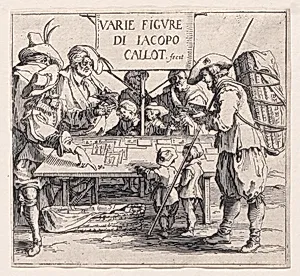
Medium
Etching; second state of three (Lieure)
Dimensions
Sheet: 3 7/16 x 3 3/4 in. (8.8 x 9.6 cm)
Classification
Prints
Department
Drawings and Prints
Museum
Metropolitan Museum of Art, New York, NY
Credit
Bequest of Edwin De T. Bechtel, 1957
Accession Number
57.650.373(1)
Rights
Public Domain
Art Historical Context
Jacques Callot's *Frontispiece, fromie Figure (Various Figures)*, created around 1620, serves as the captivating title page for a series of etchings showcasing an array of fantastical and theatrical figures. As a leading French printmaker of the Baroque era, Callot was renowned for his intricate etchings that captured the vibrancy of street life, festivals, and grotesque characters. This small-scale work (just 3 7/16 x 3 3/4 inches) exemplifies his mastery in transforming everyday scenes into dynamic compositions, blending humor, satire, and meticulous detail. Etched in the second state of three—as catalogued by artist scholar Louis Lieure—this print highlights Callot's innovative technique. Using a fine etching needle on a copper plate, he achieved extraordinary line density and texture, allowing for subtle revisions across states that refined shading and composition. Varie Figure likely drew from Italian commedia dell'arte influences, reflecting the cultural fascination with performers and oddities during Europe's early 17th-century courts. Housed in the Metropolitan Museum of Art's Drawings and Prints department through the bequest of Edwin De T. Bechtel in 1957, this frontispiece invites visitors to appreciate Callot's role in elevating printmaking to fine art, bridging popular entertainment with enduring technical brilliance.
About the Artist
Jacques Callot · 1592–1635
Jacques Callot (1592–1635) was a French printmaker and draftsman from the Duchy of Lorraine, widely regarded as one of the first great artists to practice the graphic arts exclusively. His more than 1,400 etchings chronicled the breadth of 17th-century life, from Medici court festivities to the brutal realities of warfare. Callot revolutionized etching through technical innovations including the é...