
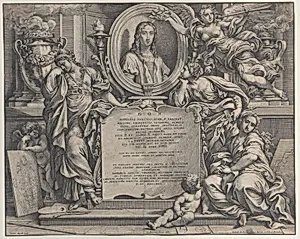
Frontispiece with oval portrait of Raphael, with three allegorical figures of the Arts supporting the tablet at center
Medium
Etching
Dimensions
Sheet (Trimmed): 12 1/4 × 15 1/4 in. (31.1 × 38.8 cm)
Classification
Prints
Department
Drawings and Prints
Museum
Metropolitan Museum of Art, New York, NY
Credit
The Elisha Whittelsey Collection, The Elisha Whittelsey Fund, 1947
Accession Number
47.100.613
Rights
Public Domain
Art Historical Context
This elegant etching from 1675 serves as a grand frontispiece, honoring the Renaissance master Raphael (Raffaello Sanzio da Urbino) through an oval portrait at its center. Flanking the image are three allegorical female figures representing Painting, Sculpture, and Architecture—the core Arts—bearing a tablet inscribed in tribute. Designed by the prominent Baroque artist Carlo Maratti, it was masterfully etched by Pietro Aquila and by Giovanni Giacomo de Rossi, key figures in Rome's vibrant printmaking scene. Created over 150 years after Raphael's death, the print reflects the 17th-century revival of interest in classical antiquity and High Renaissance ideals amid the Baroque era. Maratti, a leading painter in papal Rome, drew on Raphael's legacy to embody artistic perfection, while Aquila's precise etching technique—using acid to bite intricate lines into a metal plate—captured subtle textures and dramatic shading with remarkable fidelity. De Rossi's firm specialized in reproductive prints, disseminating such homage across Europe. Housed in the Metropolitan Museum of Art's Drawings and Prints department (The Elisha Whittelsey Collection, 1947), this 12¼ × 15¼-inch sheet (trimmed) underscores etching's role in democratizing art history, allowing collectors to own a piece of Raphael's enduring fame. A testament to cross-generational reverence, it invites us to marvel at how the Arts themselves uphold genius.
About the Artist
Carlo Maratti|Raphael (Raffaello Sanzio or Santi)|Pietro Aquila|Giovanni Giacomo De Rossi · 1625–1713
Son of a Dalmatian father. Known as the last major Italian artist of the classical tradition, which had originated with Raphael. He created a grandiose and decorative style that was valued by his ecclesiastical patrons. Comment on works: History; Religious.