
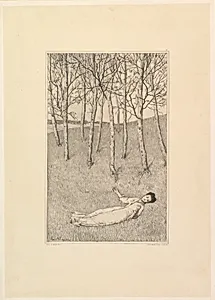
Frühlingsanfang, from the series "Radierte Skizzen"
n.d.
Medium
Etching and aquatint on chine collé
Dimensions
Sheet: 16 1/8 × 11 5/8 in. (40.9 × 29.5 cm)
Classification
Prints
Department
Drawings and Prints
Museum
Metropolitan Museum of Art, New York, NY
Credit
Gift of the Estate of Mrs. Edward Robinson, 1952
Accession Number
52.594.18
Rights
Public Domain
Tags
Art Historical Context
Max Klinger's *Frühlingsanfang (Beginning of Spring), from his series *Radierte Skizzen* (Etched Sketches), captures poetic awakening of nature through delicate imagery of women and trees. As a leading German Symbolist artist active in the late 19 and early 20th, Klinger was renowned for his intricate prints that blended fantasy, mythology, and the natural world, influencing movements like Jugendstil. This undated work exemplifies his skill in transforming sketches into evocative prints, evoking renewal and the sensual harmony between humanity and the seasons. Printed in etching and aquatint on chine collé—a technique where a thin, absorbent Chinese paper is adhered to a stronger support during printing—*Frühlingsanfang* achieves remarkable tonal depth and subtlety. Etching provides precise lines for organic forms, while aquatint adds velvety textures to foliage and figures, mimicking the softness of drawing. This labor-intensive method highlights Klinger's mastery of intaglio printing, allowing for nuanced shading that brings the spring motif to life. Housed in the Metropolitan Museum of Art's Drawings and Prints department, this gift from the Estate of Mrs. Edward Robinson in 1952 invites visitors to appreciate Klinger's innovative graphic artistry. At 16 1/8 × 11 5/8 inches, its intimate scale draws the eye to symbolic details, celebrating nature's rebirth in a timeless, dreamlike vision.
About the Artist
Max Klinger · 1857–1920
Max Klinger, born on February 18, 1857, in Leipzig to a wealthy family, emerged as one of Germany's most innovative artists across painting, sculpture, printmaking, and graphics. Demonstrating early talent, he enrolled at the Academy of Fine Arts in Karlsruhe in 1874 as a pupil of Karl Gussow, following his teacher to the Berlin Academy upon Gussow's appointment as director, and graduated in 1877 ...