
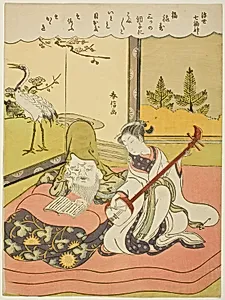
Fukurokuju, from the series "The Seven Gods of Good Luck in the Floating World (Ukiyo Shichi Fukujin)"
c. 1769
Medium
Color woodblock print; chuban
Dimensions
28 × 20.4 cm (11 × 8 in.)
Classification
woodblock print
Department
Arts of Asia
Museum
Art Institute of Chicago
Accession Number
6725
Rights
Public Domain
Art Historical Context
Behold Suzuki Harunobu's enchanting *Fukurokuju, from the series "The Gods of Good Luck in Floating World (Uki Shichi Fukujin* (c. 1769), a vibrant color woodblock print in the compact chuban format (28 × 20.4 cm). This piece from the Art Institute of Chicago Arts of Asia collection captures Fukurokuju, the Shinto god of happiness, wealth, and longevity often depicted with his distinctive elongated forehead and crane companion—symbols of wisdom and eternal life. Harunobu, a master of the ukiyo-e ("pictures of the floating world") genre, revolutionized Japanese printmaking in the 1760s by pioneering full-color nishiki-e prints. These affordable, mass-produced works brought Edo-period urban culture to everyday viewers, blending mythological figures like the Seven Gods of Good Luck with the playful, ephemeral spirit of the floating world. The chuban size made them ideal for intimate display in homes or as New Year's talismans, invoking prosperity. This print exemplifies Harunobu's delicate linework, subtle gradations (via bokashi shading), and lush colors achieved through precise woodblock layering. Culturally, it reflects 18th-century Japan's fusion of folklore and popular entertainment, offering visitors a glimpse into the auspicious optimism that charmed the masses.
About the Artist
Suzuki Harunobu · 1725–1770
Suzuki Harunobu (c. 1725-1770) was a Japanese ukiyo-e artist who revolutionized woodblock printing by developing nishiki-e—full-color prints using multiple woodblocks—in 1765. Before Harunobu, Japanese prints were limited to two or three colors; his innovation unleashed the entire artist's palette, transforming ukiyo-e into the vibrant art form that would later captivate Western artists from Manet...