
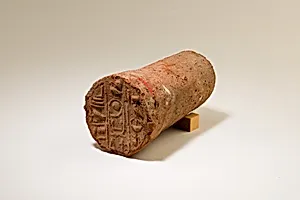
Funerary Cone of the Wab-Priest Amenemhab
Unknown Artist
ca. 1525–1504 B.C.
Medium
Pottery
Dimensions
Preserved L. 12 cm (4 3/4 in); diam. 7.1 cm (2 13/16 in)
Classification
Cone, circular impression, Amenemhab, wab-priest
Period
New Kingdom
Department
Egyptian Art
Museum
Metropolitan Museum of Art, New York, NY
Credit
Rogers Fund and Edward S. Harkness Gift, 1913
Accession Number
13.180.53
Rights
Public Domain
Tags
Art Historical Context
Step into the world of ancient Egyptian afterlife rituals with the *Funerary Cone of the Wabriest Amenemhab a modest yet poignant pottery artifact from Egypt's New Kingdom, Dynasty18 (ca. 1525–1504 B.C.). Measuring just 12 cm long and 7.1 cm in, this preserved cone was designed to be embedded above a tomb entrance, its tapered shape evoking rays of the sun and symbolizing eternal renewal. Crafted from fired clay, these cones were mass-produced yet personalized, serving as humble memorials for middle-class officials like Amenemhab, a wab-priest responsible for ritual purification in temples. Inscribed with hieroglyphs bearing the priest's name and titles, the cone played a vital role in funerary culture, publicly invoking passersby to recite offering formulas for the deceased's ka (spirit). This practice peaked during the 18th Dynasty, a golden age of imperial expansion under pharaohs like Thutmose I, reflecting a society's deep belief in immortality and communal piety. The pottery medium—durable, affordable, and ideal for incising precise hieroglyphs—highlights innovative techniques blending utility and symbolism. Today, this cone graces the Egyptian Art collection at The Metropolitan Museum of Art, acquired through the Rogers Fund and Edward S. Harkness Gift in 1913, offering visitors a tangible link to the Nile Valley's eternal quest for the afterlife.