
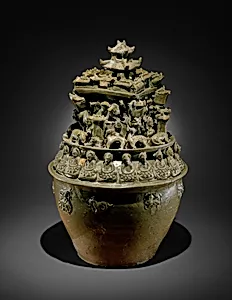
西晉 越窯神人樓閣紋青瓷瓶(魂瓶)|Funerary Urn (Hunping)
Unknown Artist
Medium
Stoneware with olive green glaze (Yue ware)
Dimensions
H. 17 7/8 in. (45.4 cm); W. 11 15/16 in. (30.3 cm)
Classification
Ceramics
Culture & Period
China · Western Jin dynasty (265–316)
Department
Asian Art
Museum
Metropolitan Museum of Art, New York, NY
Credit
Charlotte C. and John C. Weber Collection, Gift of Charlotte C. and John C. Weber, 1992
Accession Number
1992.165.21
Rights
Public Domain
Tags
Art Historical Context
This exquisite funerary urn, known as a *hunping* or soul bottle, hails from China's Western Jin dynasty (265316 CE), a time of political transition following the Han empire's fall. Crafted in the renowned Yue kilns of Zhejiang province, it stands 17⅞ inches tall and exemplifies early stoneware ceramics with an olive-green celadon glaze—a hallmark of Yue ware that foreshadowed imperial porcelain traditions. These jars were vital in funerary rituals, believed to house the departing soul (*hun*) on its journey to the afterlife. The bottle's surface bursts with lively raised-relief decorations: divine figures (*shenren*) amid towering multi-story pavilions, surrounded by elephants, birds, and other mythical animals. This bustling scene evokes a celestial realm, blending human, animal, and supernatural elements in a harmonious cosmic vision—a rare glimpse into Jin-era cosmology and artistry. As part of the Metropolitan Museum of Art's Asian Art collection (gift of Charlotte C. and John C. Weber, 1992), this urn highlights Yue potters' technical prowess in high-fired glazes and molding, bridging Han realism with later Taoist mysticism. A true treasure for contemplating ancient beliefs in immortality.