
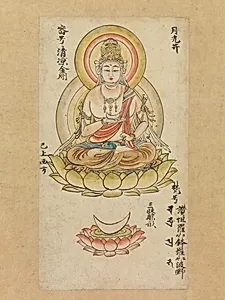
伝託磨為遠筆 月光菩薩像 「金胎仏画帖」断簡|Gakkō Bosatsu, from “Album of Buddhist Deities from the Diamond World and Womb World Mandalas” (“Kontai butsugajō”)
mid-12th century
Medium
Page from a book mounted as a hanging scroll; ink, color, and gold on paper
Dimensions
10 × 5 3/8 in. (25.4 × 13.7 cm) Overall with mounting: 49 1/4 × 15 1/2 in. (125.1 × 39.4 cm) Overall with knobs: 49 1/4 × 17 3/4 in. (125.1 × 45.1 cm)
Classification
Paintings
Culture & Period
Japan · Heian period (794–1185)
Department
Asian Art
Museum
Metropolitan Museum of Art, New York, NY
Credit
The Harry G. C. Packard Collection of Asian Art, Gift of Harry G. C. Packard, and Purchase, Fletcher, Rogers, Harris Brisbane Dick, and Louis V. Bell Funds, Joseph Pulitzer Bequest, and The Annenberg Fund Inc. Gift, 1975
Accession Number
1975.268.8
Rights
Public Domain
Tags
Art Historical Context
This exquisite fragment depicts *Gakkō Bosatsu* (Moonlight Bodhisatt), a serene figure radiating lunar grace, from the rare *Album of Buddhist Deities the Diamond World and W World Mandalas* (*ai butsugajō*). Attributed to Takuma Tamō, a master of Takuma school in mid-12th-century Japan during the late Heian period (794–1185), this page—originally from a book, now mounted as a hanging scrollmeasures a delicate 10 × 5⅜ inches. Crafted with ink, color, and gold on paper, it captures the ethereal beauty of Esoteric Buddhism. The Heian era was a golden age of Japanese court culture, where Shingon and Tendai Buddhism flourished, emphasizing mandalas as cosmic diagrams of enlightenment. The Diamond World (Vajradhatu) and Womb World (Garbhadhatu) mandalas visualized the universe's dual aspects—wisdom and compassion—with deities like Gakkō Bosatsu symbolizing the moon's purifying light, guiding devotees toward spiritual awakening. Takuma Tametō's work exemplifies *yamato-e* influences blended with Buddhist iconography, showcasing the school's refined, aristocratic style prized by nobility. The lavish use of gold evokes divine radiance, a technique highlighting the scroll's sacred status amid Heian-era opulence. Now at the Metropolitan Museum of Art, this survivor from the Harry G. C. Packard Collection invites visitors to ponder the interplay of art, faith, and celestial harmony in medieval Japan.