
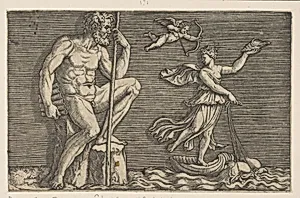
Galatea escaping Polyphemus; he is seated on a rock holding a staff and pipes and looking towards Galatea at right riding a shell pulled by two dolphins, Cupid flying above
ca. 1515–27
Medium
Engraving
Dimensions
Sheet (Trimmed): 4 3/8 × 6 13/16 in. (11.1 × 17.3 cm)
Classification
Prints
Department
Drawings and Prints
Museum
Metropolitan Museum of Art, New York, NY
Credit
Harris Brisbane Dick Fund, 1926
Accession Number
26.50.1(133)
Rights
Public Domain
Tags
Art Historical Context
In this enchanting engraving titled *Galatea Escaping Polyphemus*, artist Marco Dente captures a dramatic moment from Ovid's *amorphoses*. Created around 1515–27, the scene depicts the sea nymph Galatea fleeing the lovesick Cyclops Polyphem on a shell drawn by two dolphins, with the mischievous Cupid soaring above. Polyphemus, seated a rocky outcrop, clutches his staff and panpipes, his gaze fixed longingly on the escaping figure—a poignant nod to unrequited love in classical mythology. Dente, a skilled engraver from Ravenna active during the High Renaissance, excelled in translating intricate designs into prints, often drawing from masters like Raphael. Engraving, a meticulous intaglio technique where lines are incised into a copper plate for inking and printing, allowed such small-scale works (here trimmed to 4 3/8 × 6 13/16 in.) to disseminate mythological narratives widely among collectors. The composition bursts with dynamic movement, nude male figures emphasizing Renaissance ideals of anatomy and grace, while the tags highlight themes of male nudes, Cupid, and Galatea. Acquired through the Harris Brisbane Dick Fund in 1926, this print from the Metropolitan Museum of Art's Drawings and Prints department exemplifies how Renaissance artists popularized ancient tales, blending eroticism, drama, and humanism for an educated elite. A gem for mythology enthusiasts!
About the Artist
Marco Dente · 1515–1527
Marco Dente (died 1527), also known as Marco da Ravenna, was among the most accomplished printmakers working in Rome during the High Renaissance, a period that witnessed an extraordinary flowering of engraving as both a reproductive and an independent artistic medium. Little is known of his early training, but by the second decade of the sixteenth century he had established himself in the orbit of...