
Galleria Giustiniana del Marchese Vincenzo Giustiniani I
1640
Medium
engraving
Dimensions
373; 238
Rights
Public Domain
About this artwork
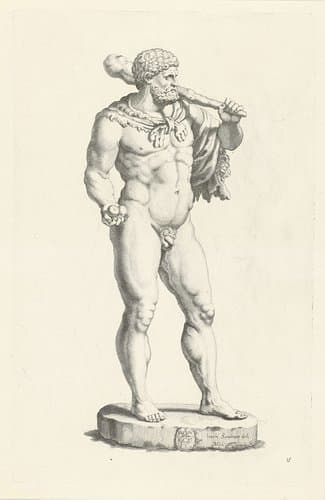
Standbeeld van Hercules met de appelen van de Hesperiden in zijn linkerhand, de knots in zijn rechterhand, die hij op zijn schouder laat rusten. Om zijn hals is de huid van de leeuw geknoopt. Midden onder op de basis het wapenschild van Vincenzo Giustiniani. Prent uit een serie naar de sculpturen in de verzameling in de Galleria Giustiniani te Rome.
Art Historical Context
Step into the grand world of 17th-century Roman art collecting with *Galleria Giustiniani del Marchese Vincenzo Giustiniani*, a masterful 1640 engraving by Flemish artist Michel Natalis. This detailed print (373 × 238 mm) captures a classical statue of Hercules, the mighty hero triumphant from his final labor. In his left hand, he cradles the golden apples of the Hesperides; his right rests a hefty club on his shoulder, while the Nemean lion's skin drapes knotted around his neck. At the statue's base gleams the coat of arms of Vincenzo Giustiniani, proud owner of one of Europe's most celebrated collections. Created as part of a lavish series documenting the sculptures in Rome's Galleria Giustiniani—Giustiniani's opulent palace gallery—this engraving served as a visual catalog for Europe's elite. Vincenzo, a Genoese banker and avid antiquities collector, amassed hundreds of ancient marbles, turning his home into a Renaissance-era museum. Natalis's precise engraving technique, with its intricate lines and tonal depth, faithfully reproduced the marble's texture and drama, making these treasures accessible beyond Rome's walls during the Baroque age. These prints weren't just art; they fueled the era's fascination with classical mythology and heroism, inspiring artists like Bernini and spreading Giustiniani's legacy. Today, they remind us how engravings democratized high culture, bridging ancient myths to modern admirers.