
Garde
1851 - 1862
Medium
lithography
Dimensions
474; 329
Rights
Public Domain
About this artwork
check stamp: Lugt 36a
Art Historical Context
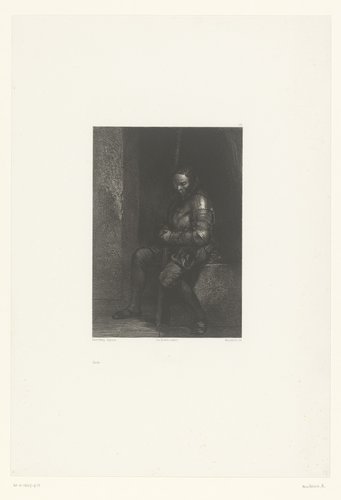
Adolphe Mouilleron’s *Garde* (1851–1862) is a striking example of mid-nineteenth-century lithography, a medium that transformed how art reached wider audiences. Working in France during the rise of Romanticism and early Realism, Mouilleron specialized in reproductive prints that captured the drama and texture of paintings with remarkable fidelity. Measuring roughly 47 by 33 centimeters, this large-format lithograph showcases the artist’s command of tonal gradations and fine line work, allowing subtle light effects and surface details to emerge from the stone. The presence of the Lugt 36a collector’s stamp indicates that the sheet once belonged to a distinguished European collection, underscoring its historical value as both an artwork and a document of print connoisseurship. Lithography’s affordability and capacity for rich blacks and delicate shading made it ideal for disseminating images of contemporary or old-master paintings to the growing middle-class public. Today, *Garde* offers visitors a window into the vibrant print culture of Second Empire France, where technical innovation met artistic ambition. Its crisp impressions and careful modeling remind us how lithography helped shape modern visual literacy long before photography became widespread.
About the Artist
Adolphe Mouilleron · 1820–1881
Adolphe Mouilleron (1820–1881) was a French painter and lithographer whose significant contributions to French printmaking and co-founding role in the artists' collective 'Les Artistes Contemporains' made him an important figure in mid-19th-century Parisian art. Born in Paris on December 20, 1820, Mouilleron achieved recognition through both his original lithographs and paintings, earning multiple...