
Gardens of the Villa Correr, near Strà (recto); Study for The Transverberation of Saint Teresa of Jesus and a Study of Hands (verso)
1712–93
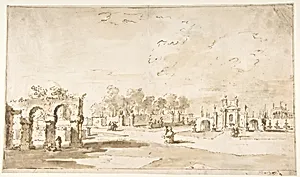
Medium
Pen and brown ink, brush and brown wash, over charcoal (recto). Framing lines in pen and brown ink; charcoal (verso)
Dimensions
sheet: 9 1/16 x 15 1/2 in. (23 x 39.4 cm)
Classification
Drawings
Department
Drawings and Prints
Museum
Metropolitan Museum of Art, New York, NY
Credit
Rogers Fund, 1937
Accession Number
37.165.77
Rights
Public Domain
Tags
Art Historical Context
This exquisite double-sided drawing by Francesco Guardi, a master of 18th-century Venetian art, captures the artist's versatility on a modest sheet measuring just over 9 by 15 inches. On the recto, Guardi sketches the lush *Gardens of the Villarer near Strà*, a grand patrician estate along the Brenta Canal. Using pen and brown ink, and brown wash over charcoal, he evokes the elegant symmetry of Venetian Renaissance gardens—clipped hedges, fountains, and pavilions—infused with his signature atmospheric lightness. This technique, layering fluid washes for depth and subtle highlights, reflects Guardi's evolution from Rococo whimsy toward more impressionistic effects, bridging Canaletto's precision and Tiepolo's fantasy. Flipping to the verso reveals a stark contrast: a preparatory study for *The Transverberation of Saint Teresa of Jesus*—the mystic's visionary ecstasy pierced by an angel's arrow—alongside delicate hand studies. Quick charcoal strokes and framing lines in pen and ink highlight Guardi's skill in rendering dynamic religious drama, a nod to Counter-Reformation fervor still resonant in Catholic Venice. These sketches, likely from mid-career (c. 1750s–80s), showcase his preparatory process for oil paintings, blending architectural precision with emotive figures. Housed in The Metropolitan Museum of Art's Drawings and Prints department (Rogers Fund, 1937), this work illuminates Guardi's world: opulent villas symbolizing Venice's fading aristocracy and saints embodying spiritual intensity. A window into the artist's fluid creativity, it invites us to appreciate the humble sketch as a seed of grandeur.
About the Artist
Francesco Guardi · 1712–1793
Francesco Lazzaro Guardi (1712–1793) was born into a noble family of painters from Trentino who had settled in Venice. His father, Domenico Guardi, a minor painter trained in Vienna, died in 1716, leaving young Francesco to inherit the family workshop alongside his brothers Giovanni Antonio (Gian Antonio) and Niccolò, both artists, and sister Maria Cecilia, who married the renowned Giovanni Battis...