
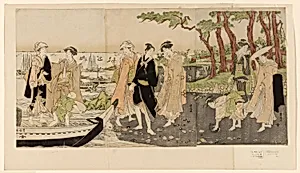
Gathering shell fish at low tide
c. 1789/1801
Medium
Color woodblock print; oban triptych
Dimensions
Each sheet approx: 40 × 25.4 cm (15 3/4 × 10 in.)
Classification
woodblock print
Department
Arts of Asia
Museum
Art Institute of Chicago
Accession Number
21426
Rights
Public Domain
Art Historical Context
**Gathering Shellfish at Low Tide** by Utagawa Toyok I (1769–1825) captures a lively snapshot of everyday life along Japan's coastline during the late Edo period (c. 1789–1801). This vibrant color woodblock print, presented as an oban triych—three large sheets (each about 40 × 25.4 cm) that to form a panoramic scene—depicts villagers busily foraging for shellfish as the tide recedes. Toyokuni I, a master of the Utagawa school and pioneer in ukiyo-e ("pictures of the floating world"), was renowned for his dynamic portrayals of kabuki actors, beauties, and genre scenes, blending keen observation with theatrical flair. Woodblock printing, the medium here, was a revolutionary technique in 18th-century Japan, allowing affordable mass production of colorful art for urban audiences. Artisans carved intricate blocks for each color, layering pigments like Prussian blue and vermilion to achieve Toyokuni's signature bold lines and vivid hues. The triptych format amplified the immersive quality, inviting viewers into the rhythm of labor and nature. Housed in the Art Institute of Chicago's Arts of Asia department, this print reflects ukiyo-e's cultural role in celebrating transient pleasures and common folk amid Japan's isolationist era. It offers a window into pre-industrial coastal life, where community and seasonal bounty intertwined, making it a gem for understanding Edo-period vibrancy.
About the Artist
Utagawa Toyokuni I · 1777–1835
Japanese, 1777–1835