
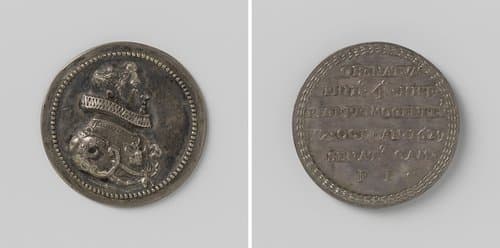
Geboorte van Balthasar Karel, eerste zoon van Philips IV, penning geslagen op last van de raad van Kamerijk
1629
Medium
casting
Dimensions
4.4; 24.87
Rights
Public Domain
About this artwork
Zilveren penning. Voorzijde: borststuk man. Keerzijde: opschrift
Art Historical Context
This exquisite silver medal, struck in 1629 to commemorate the birth of Basar Charles—the first son and heir of Spain's King Philip IV—offers a glimpse into the celebratory propaganda of the Spanish Habsburg era. Commissioned by the council of Cambrai (Kamerijk), a key city in the Spanish Netherlands amid ongoing conflicts like the Eighty Years' War, it reflects the era's fervor for royal lineage and dynastic continuity. At just 4.4 cm in diameter and weighing 24.87 grams, its intimate scale made it ideal for distribution among elites, symbolizing loyalty to the distant Spanish crown. Crafted anonymously using casting techniques, the medal features a detailed obverse bust of a man—likely Philip IV himself—capturing the regal poise typical of Baroque portraiture. The reverse bears an inscription heralding the joyous event, a common motif in numismatic art that blended artistry with political messaging. Such medals were not mere trinkets but powerful tools for fostering unity in far-flung territories. Though Balthasar Charles tragically died young in 1646, this artifact endures as a testament to 17th-century hopes for imperial stability, showcasing the refined craftsmanship of European medallic art during a turbulent age.
About the Artist
anonymous
In the vast tapestry of art history, "Anonymous" stands not as a singular individual but as a collective designation for countless unidentified creators whose works have endured across millennia. These artists, spanning prehistoric cave painters to medieval illuminators and folk craftsmen, produced the foundational layers of human visual culture. Prior to the Renaissance, when individual fame emer...