
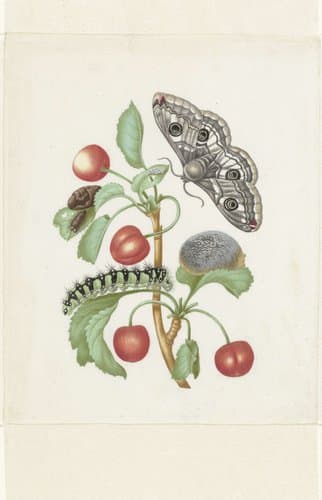
Gedaanteverwisseling van de nachtpauwoog
na 1679
Medium
opaque and transparent watercolour, over traces of graphite, on vellum
Dimensions
192; 155
Rights
Public Domain
About this artwork
penseel in waterverf en dekverf, over sporen van grafiet, op perkament
Art Historical Context
**Gedaanteverwiss van de nachtpauog (Metamorphosis of the Owl Moth)** *Maria Sibylla Merian, after 1679* Maria Sibylla Merian, a pioneering 17th naturalist and artist, captured the enchanting life cycle of the owl moth—known as *nachtpauwoog* in Dutch—in this exquisite study. Created after 1679, during her prolific period documenting insect transformations in Europe, the work reflects her groundbreaking approach to blending scientific observation with artistic beauty. Merian's illustrations challenged the era's symbolic depictions of nature, offering precise, naturalistic portrayals that advanced entomology and inspired later biologists. Rendered in opaque and transparent watercolours over faint graphite traces on delicate vellum (animal skin parchment), the piece measures a intimate 192 × 155 mm. Vellum's smooth, translucent surface allowed Merian to layer colours for luminous depth, mimicking the moth's iridescent wings and the subtle textures of caterpillar, pupa, and adult stages. This mixed technique—graphite for initial sketches, then watercolour for vibrant realism—highlights her mastery in small-scale works, often prepared for her seminal books like *Der Raupen wunderbare Verwandelung*. Merian's art bridged art and science, elevating women in natural history. This metamorphosis study invites visitors to marvel at nature's wonders through her keen eye, a testament to her enduring legacy in scientific illustration. (198 words)