
Georg Arsenius
1898
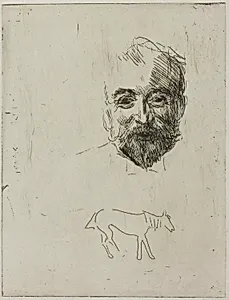
Medium
Etching on ivory laid paper
Dimensions
Image/plate: 13.1 × 10 cm (5 3/16 × 3 15/16 in.); Sheet: 33.8 × 23 cm (13 5/16 × 9 1/16 in.)
Classification
etching
Department
Prints and Drawings
Museum
Art Institute of Chicago
Accession Number
41785
Rights
Public Domain
Art Historical Context
Anders Zorn (1860–1920), one of Sweden’s most celebrated artists of the late nineteenth century, created this intimate portrait etching in 1898. Known internationally for his fluid handling of light and form, Zorn turned to printmaking throughout his career, producing etchings that rivaled his paintings in popularity. The small plate size of just over five inches suggests a personal study, likely capturing Georg Arsenius, a friend or acquaintance, with directness and economy. Etching on ivory laid paper allowed Zorn to achieve remarkably delicate lines and subtle tonal gradations through the controlled use of acid on a metal plate. This technique suited his interest in rendering texture—whether fabric, hair, or skin—with minimal means. The larger sheet provides generous margins, a presentation choice typical of fine-art prints meant for collectors rather than mass reproduction. Today housed in the Art Institute of Chicago’s Department of Prints and Drawings, the work exemplifies the Etching Revival’s emphasis on original printmaking as a serious artistic medium. Its modest scale invites close looking, rewarding viewers with the quiet intensity characteristic of Zorn’s graphic portraits.
About the Artist
Anders Zorn · 1860–1920
Anders Zorn (1860–1920), one of Sweden's most celebrated artists, was born on February 18 in Utmeland near Mora in Dalarna, and raised on his maternal grandparents' farm in the nearby hamlet of Yvraden. Displaying prodigious talent from a young age, he attended school in Mora Strand until age twelve, followed by secondary grammar school in Enköping, where he excelled in drawing people and horses. ...