
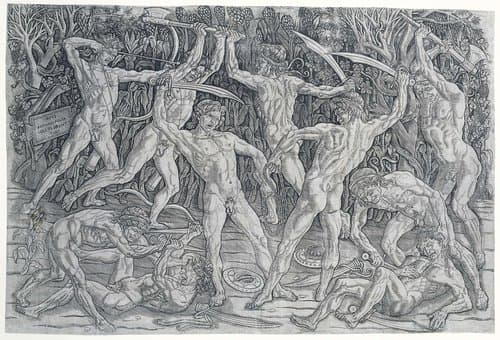
Gevecht van naakte krijgers
c. 1470 - c. 1475
Medium
engraving
Dimensions
407; 605
Rights
Public Domain
About this artwork
ets en gravure
Art Historical Context
Antonio Pollaiuolo’s *Gevecht van naakte krijgers* (Battle of the Naked Warriors), created around 1470–1475, stands as one of the most ambitious and technically accomplished engravings of the early Renaissance. Working in Florence, Pollaiuolo used the demanding medium of engraving—incising designs into a metal plate—to explore the human body in vigorous motion. The large sheet, measuring over 40 by 60 centimeters, allowed him to fill the composition with nude figures whose straining muscles and twisting poses reveal his fascination with anatomy and classical ideals of physical perfection. This print reflects the Renaissance revival of antique themes, presenting warriors in combat without armor or clothing to emphasize the beauty and power of the male form. At a time when printmaking was still emerging as a serious art form, Pollaiuolo demonstrated how engraving could rival painting and sculpture in its ability to convey energy and detail. The work’s influence quickly spread across Europe, inspiring artists to study the nude figure and experiment with dynamic compositions. Visitors often notice the remarkable precision of line and the sense of movement captured across the entire surface. As both an artistic and technical achievement, the engraving remains a landmark in the history of printmaking and a vivid expression of Renaissance humanism.