
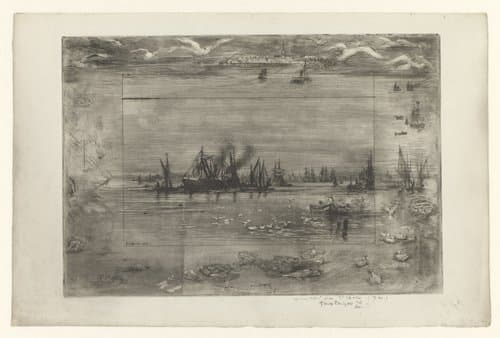
Gezicht op een haven met schepen en meeuwen
Medium
etching
Dimensions
359; 247
Rights
Public Domain
About this artwork
Karakteristiek voor Buhot zijn de illustraties die hij in de marges van zijn prenten plaatste, zoals ook bij deze prent het geval is. De inventie die hij "marges symphoniques" noemde, versterkte het hoofdonderwerp van de prent en maakte er integraal deel van uit. Buhot werd geïnspireerd door decoraties in de marges van Middeleeuwse manuscripten en achttiende-eeuwse Franse boekillustraties.
Art Historical Context
Félix Hilaire Buhot’s 1886 etching *Gez op een haven met sche en meeuwen* captures a lively harbor scene filled with ships and circling seagulls. Created during the height of the etching revival in France, the print demonstrates Buhot’s mastery of the medium, using delicate lines and tonal contrasts to evoke atmosphere and movement within a compact format measuring roughly 25 by 36 centimeters. A hallmark of Buhot’s work is his inventive use of “marges symphoniques,” or symphonic margins—illustrated borders that extend the central image rather than merely framing it. In this print, small vignettes and decorative motifs in the margins enrich the harbor view, drawing inspiration from the marginal decorations of medieval manuscripts and eighteenth-century French book illustrations. These additions transform the etching into a unified visual experience, blending narrative detail with the main subject. This approach reflects Buhot’s desire to expand the expressive possibilities of printmaking, making each impression a complete artistic statement. Visitors can appreciate how the margins invite closer looking, revealing layers of visual storytelling that complement the bustling maritime scene at the center.