
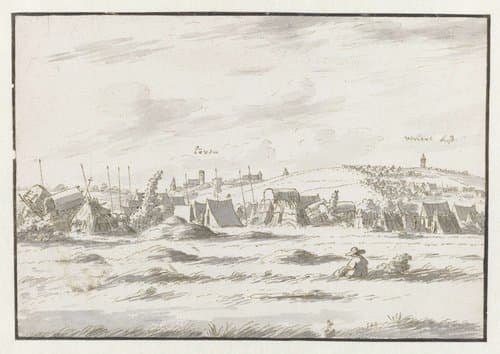
Gezicht op het kampement van het leger van Willem III bij Leuven
1675-07-13
Medium
pen and brown ink, with grey wash, over traces of graphite; framing line in black ink
Dimensions
179; 124
Rights
Public Domain
About this artwork
pen and brown ink, with grey wash, over traces of graphite; framing line in black ink
Art Historical Context
Step into the turbulent world of 17th-century Europe with *Gezicht op het kampement van het leger Willem III bij Leuven*View of the Encampment of the Army William III near Leuven), delicate drawing by Dutch artist Josua de Grave dated July 13, 1675. This intimate sheet captures a sprawling military camp on the outskirts of Leuven, in present-day Belgium, during the height of the Franco-Dutch (1672–1678). William III of Orange, the ambitious Stadtholder of the Dutch Republic, led allied forces against the expansionist Louis XIV of France, and this scene likely documents a pivotal moment of strategic positioning amid the conflict. De Grave, known for his precise topographical views and military subjects, employs a masterful technique: pen and brown ink with subtle grey wash over faint graphite underdrawing, enhanced by a framing line in black ink. Measuring just 124 × 179 mm, the work's small scale belies its documentary power, blending fine line work for tents, soldiers, and landscape details with soft washes to evoke depth and atmosphere. Such drawings were prized in the Dutch Golden Age for their immediacy, serving as on-site records that informed maps, engravings, or princely collections. This artifact offers a rare glimpse into the logistics of early modern warfare, highlighting the era's blend of artistry and reportage. Visitors will appreciate how de Grave's skilled hand immortalizes a fleeting military tableau, bridging history and visual poetry.
About the Artist
Josua de Grave · 1643–1712
Comment on works: Landscapes; Views