
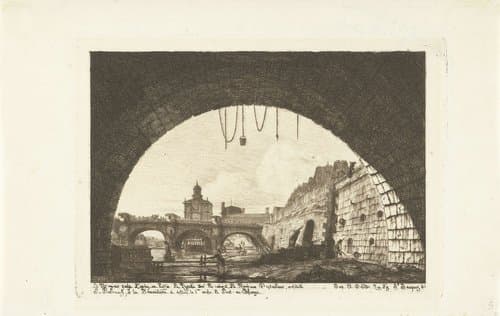
Gezicht op Pont-Neuf van onder boog Pont-au-Change in Parijs
1855
Medium
etching
Dimensions
205; 143
Rights
Public Domain
About this artwork
collector's mark: Lugt 690
Art Historical Context
**Gezicht op Pont-Neuf van boog Pont-au- in Parijs (View of the Pont-Neuf from under the Arch of the Pont-au- in Paris)** *Charles Meryon, 1855, etching, 143 × 205 mm* Charles Meryon, a pioneering French etcher of the mid-19th century, a dramatic vista of Paris's iconic Pont-Neuf bridge in this etching from his renowned *Eaux-Fortes Paris* series. Viewed from beneath the adjacent Pont-au-Change arch, the composition frames the bridge's sturdy stone arches against a moody sky, evoking the bustling yet timeless atmosphere of pre-Haussmann Paris. Completed in 1855, it preserves a vanishing urban landscape just before Baron Haussmann's sweeping renovations transformed the city. Meryon's mastery of etching—a technique where acid bites intricate lines into a metal plate—allowed for exquisite detail in textures like weathered stone and rippling water, rivaling painting in depth and atmosphere. Part of the 19th-century etching revival, his works blend Romantic realism with a haunting precision, influencing later artists like Whistler. This print bears the collector's mark Lugt 690, signaling its esteemed provenance among connoisseurs. A cultural gem, it offers visitors a window into 1850s Paris, celebrating the city's medieval bridges amid modernization's shadow—perfect for pondering how art immortalizes what time erases.
About the Artist
Charles Meryon · 1821–1868
Charles Meryon, born on November 23, 1821, in Paris, was the illegitimate son of English physician Dr. Charles Lewis Meryon and dancer Pierre-Narcisse Chaspoux (stage name Narcisse Gentil) at the Paris Opéra. His half-sister Fanny, from his mother's prior relationship with Viscount Lowther, remained in contact after their mother's death in 1838. Raised partly outside Paris before attending Pension...