
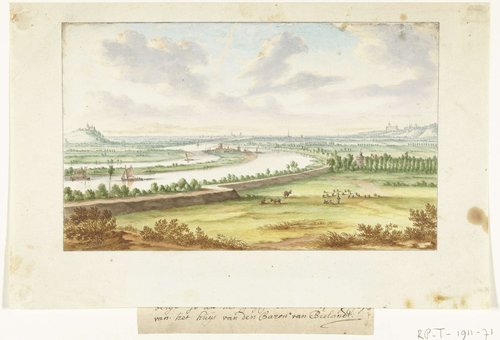
Gezicht van Schenkenschans
1666 - 1706
Medium
brush
Dimensions
155; 254
Rights
Public Domain
About this artwork
ondertekening in zwart krijt, penseel in waterverf
Art Historical Context
**Gezicht van Schenschans** by Jan van Call (I captures a precise view of the fortified town of Schenkenschans a key strategic outpost on the Rhine River in the Netherlands during the Dutch Golden Age. Created sometime between 1666 and1706, this small-scale drawing (155 × 254 mm) exemplifies Call's expertise as a topographical artist from Gelderland, renowned for his detailed depictions of regional landscapes, towns, and military fortifications. These works served both artistic and practical purposes, often informing maps, travel accounts, or military planning in an era of frequent border conflicts. The piece employs a meticulous technique: an underdrawing in black chalk provides a sturdy structural foundation, overlaid with fluid brushwork in watercolor (penseel in waterverf). This combination allowed van Call to achieve subtle tonal variations and atmospheric depth, hallmarks of 17th-century Dutch draftsmanship. Watercolor's transparency lent a luminous quality to such views, making them prized by collectors for their immediacy and realism. Schenkenschans itself holds rich history, repeatedly contested during the Eighty Years' War and later Anglo-Dutch conflicts, symbolizing Dutch resilience. Van Call's rendition invites visitors to envision the bustling life around these ramparts, blending artistry with a window into the era's geopolitical tensions. A gem for fans of historical landscapes!