
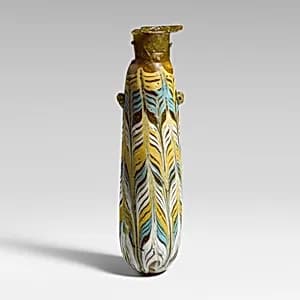
Glass alabastron (perfume bottle)
Unknown Artist
late 4th–early 3rd century BCE
Medium
Glass
Dimensions
5 1/4 × 1 9/16 × 1 3/8 in. (13.4 × 3.9 × 3.5 cm)
Classification
Glass
Culture & Period
Greek, Eastern Mediterranean · Early Hellenistic
Department
Greek and Roman Art
Museum
Metropolitan Museum of Art, New York, NY
Credit
Gift of J. Pierpont Morgan, 1917
Accession Number
17.194.753
Rights
Public Domain
Art Historical Context
This delicate glass alabastron, slender perfume bottle from the late 4th to early 3rd century BCE,ails from the Greek culture of the Eastern Mediterranean during the Early Hellenistic period. just over 5 inches tall, elegant form—narrow neck flaring to a rounded body—epitomizes the graceful functionality of ancient vessels designed to hold precious oils, perfumes, or cosmetics. Crafted as a luxury item, it reflects the cosmopolitan world shaped by Alexander the Great'ss, where Greek artistry blended with Eastern influences. Glassmaking in this era was a sophisticated craft, likely involving core-forming techniques where molten glass threads were wound around a removable core of sand or clay. Such alabastra were prized possessions, used in daily grooming rituals or as grave goods, symbolizing beauty, status, and the ephemeral nature of life. Though the artist remains unknown, the vessel's iridescent patina today hints at its original vibrant colors, now softened by millennia. A generous gift from J. Pierpont Morgan in 1917, this piece graces the Metropolitan Museum of Art's Greek and Roman Art department, offering visitors a tangible link to Hellenistic refinement and the scents of antiquity.