
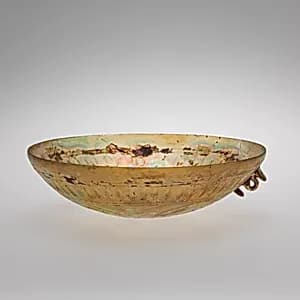
Glass bowl
Unknown Artist
4th century CE
Medium
Glass
Dimensions
H.: 2 3/8 in. (6 cm) Diam.: 8 1/4 in. (21 cm)
Classification
Glass
Culture & Period
Roman · Late Imperial
Department
Greek and Roman Art
Museum
Metropolitan Museum of Art, New York, NY
Credit
Bequest of Isaac D. Fletcher, 1917
Accession Number
17.120.242
Rights
Public Domain
Art Historical Context
This delicate glass bowl from the 4th century CE exemplifies refined craftsmanship of Late Imperial Rome. Standing just 2⅜ inches (6 cm) tall with an impressive 8¼-inch (21 cm) diameter, its shallow, wide form suggests it was designed for practical yet elegant use—perhaps holding fruits, confections, or oils in a wealthy household. Crafted during a time when the Roman Empire spanned vast territories, such vessels highlight the era's advanced glassmaking, a staple of Mediterranean trade and daily luxury. Roman glass production reached its zenith in the Late Imperial period, thanks to innovations like glassblowing introduced centuries earlier. Artisans shaped molten glass over a blowpipe, allowing for thin-walled, lightweight forms that were both affordable and artistic. This bowl, though by an unknown maker, reflects the standardization and quality of workshops in regions like the Eastern Mediterranean, where glass was colored, engraved, or trailed with threads for decoration—techniques that made it accessible beyond elite circles. Today, housed in the Metropolitan Museum of Art's Greek and Roman Art department (bequest of Isaac D. Fletcher, 1917), this unassuming treasure offers a glimpse into Roman domestic life. Its survival speaks to glass's durability and the enduring allure of Roman ingenuity, reminding us how everyday objects can illuminate a civilization's sophistication.