
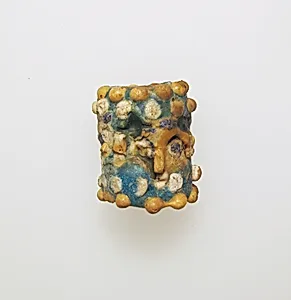
Glass face bead
Unknown Artist
end of 5th–mid-2nd century BCE
Medium
Glass
Dimensions
Other: 7/8 in. × 11/16 in. (2.3 × 1.7 cm)
Classification
Glass
Culture & Period
Phoenician or Carthaginian · Late Classical or Hellenistic
Department
Greek and Roman Art
Museum
Metropolitan Museum of Art, New York, NY
Credit
Gift of J. Pierpont Morgan, 1917
Accession Number
17.194.716
Rights
Public Domain
Tags
Art Historical Context
This delicate glass face bead, crafted an unknown Phoenician or Carthaginian artisan between the late 5th and mid-2nd century, exemplifies the exquisite miniaturization of ancient glassworking during the Late Classical to Hellenistic periods. Measuring just 7/8 by 11/16 inches (2.3 × 1.7 cm), its diminutive scale belies the technical prowess required to mold or shape vibrant glass into a detailed human visage, likely intended as a bead for jewelry or an amulet. Phoenicians and Carthaginians were master traders and innovators in glass production, exporting colorful beads across the Mediterranean world. This artifact, housed in the Metropolitan Museum of Art's Greek and Roman Art Department (gift of J. Pierpont Morgan, 1917), reflects their cultural influence amid interactions with Greek and Roman societies. The face motif—common in such beads—may have held protective or symbolic significance, invoking ancestral spirits or warding off misfortune in daily life. Today, this tiny treasure invites us to marvel at ancient ingenuity: how artisans captured expressive features in fragile glass, bridging personal adornment with profound cultural beliefs. A window into the vibrant ancient world!