
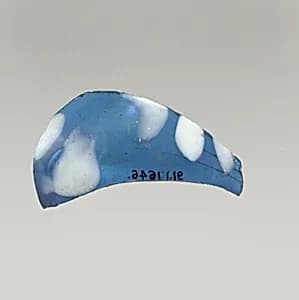
Glass fragment
Unknown Artist
1st century CE
Medium
Glass
Dimensions
Other: 1 x 2 1/4 in. (2.6 x 5.7 cm)
Classification
Glass
Culture & Period
Roman · Early Imperial
Department
Greek and Roman Art
Museum
Metropolitan Museum of Art, New York, NY
Credit
Edward C. Moore Collection, Bequest of Edward C. Moore, 1891
Accession Number
91.1.1646
Rights
Public Domain
Art Historical Context
This delicate glass fragment, dating to the 1st century CE during Rome's Early Imperial period, a glimpse into the everyday artistry of the ancient world. Crafted in the Roman culture, it measures just 1 x 2¼ inches (2.6 x 5.7 cm), likely a shard from a larger vessel or object. The Early Imperial era, under emperors like Augustus and Tiberius, marked a golden age for Roman craftsmanship, when glass production boomed thanks to innovations like glassblowing around 50 BCE. This technique allowed for affordable, mass-produced translucent wares that brought luxury to homes across the empire. Glass was a prized medium in Roman society, valued for its clarity, vibrant colors, and versatility—from tableware to lamps and cosmetics containers. Though small, this fragment exemplifies the technical finesse of Roman glassmakers, who mastered molding, cutting, and coloring with minerals for striking effects. Such pieces highlight how glass bridged utility and beauty, reflecting Rome's expansive trade networks that imported raw materials from the Levant and Egypt. Now part of the Metropolitan Museum of Art's Greek and Roman Art department, this artifact entered the collection via the Edward C. Moore bequest in 1891. Moore, a passionate 19th-century collector, amassed exceptional examples of ancient glass, preserving these fragile treasures for modern eyes. Imagine holding a piece of imperial Rome—its iridescent whisper of history endures.