
Glass monochrome dish fragment
Unknown Artist
1st half of 1st century CE
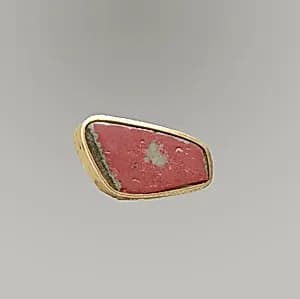
Medium
Glass
Dimensions
Other: 11/16 x 1 3/8 in. (1.7 x 3.4 cm)
Classification
Glass
Culture & Period
Roman · Early Imperial, Julio-Claudian
Department
Greek and Roman Art
Museum
Metropolitan Museum of Art, New York, NY
Credit
Edward C. Moore Collection, Bequest of Edward C. Moore, 1891
Accession Number
91.1.1751
Rights
Public Domain
Art Historical Context
This delicate fragment from a monochrome glass dish offers a glimpse into the refined world of Early Imperial Rome during the Julio-Claudian period (ca. 1st half of 1st century CE). Dating to the reigns of emperors like Augustus or Tiberius, it reflects the height of Roman expansion and cultural sophistication, when glassware became a staple of elite households and trade across the empire. Though only a small shard measuring 1.7 x 3.4 cm survives, it hints at a once-complete dish likely used for serving food or drink, showcasing everyday luxury. Roman glassmaking reached new heights in this era, with innovations like mold-blowing and free-blowing enabling mass production of vibrant, functional vessels. The monochrome design—crafted in a single, uniform color—highlights the technical prowess of ancient artisans, who manipulated molten glass for both durability and aesthetic appeal. Such pieces were prized for their clarity and translucency, often imitating more precious materials like rock crystal. Now housed in the Metropolitan Museum of Art's Greek and Roman Art Department as part of the Edward C. Moore Collection (bequeathed 1891), this fragment preserves a tangible link to Roman domestic life. It reminds us how commonplace objects embodied imperial innovation and artistry.