
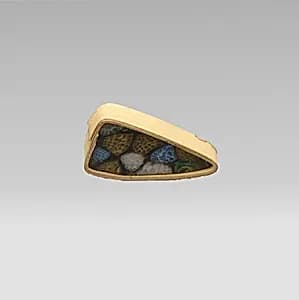
Glass mosaic fragment
Unknown Artist
late 1st century BCE–early 1st century CE
Medium
Glass
Dimensions
Other: 5/8 x 1 5/16 in. (1.7 x 3.3 cm)
Classification
Glass
Culture & Period
Roman · Early Imperial
Department
Greek and Roman Art
Museum
Metropolitan Museum of Art, New York, NY
Credit
Edward C. Moore Collection, Bequest of Edward C. Moore, 1891
Accession Number
91.1.1875
Rights
Public Domain
Art Historical Context
This delicate glass mosaic fragment, dating to the late 1st century BCE early 1st century CE, offers a glimpse into the opulent world of Early Imperial Rome. Crafted during the reign of Augustus and his successors, when Rome transitioned from republic to empire, such pieces adorned luxurious villas, public baths, and elite tableware. Though tiny—measuring just 5/8 x 1 5/16 inches—it exemplifies Roman innovation in glassworking, a craft that flourished with advanced furnace techniques and trade in vibrant pigments. Roman glass mosaics, like this one, were created by cutting thin slabs of colored glass (known as smalti or sectile) into precise shapes and embedding them into a cement or plaster bed. This method produced durable, shimmering surfaces that mimicked more precious materials like marble or gems, symbolizing wealth and status. The fragment's survival highlights the era's technical prowess, as Romans perfected millefiori and opus sectile styles for both functional and decorative purposes. Now part of the Metropolitan Museum of Art's Greek and Roman Art collection, thanks to the Edward C. Moore bequest of 1891, this artifact invites us to imagine the grand pavements and vessels it once enhanced, bridging ancient craftsmanship with modern appreciation.