
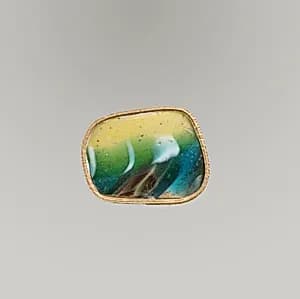
Glass mosaic fragment
Unknown Artist
late 1st century BCE–early 1st century CE
Medium
Glass
Dimensions
H.: 1 1/4 x 15/16 in. (3.1 x 2.4 cm)
Classification
Glass
Culture & Period
Roman · Early Imperial
Department
Greek and Roman Art
Museum
Metropolitan Museum of Art, New York, NY
Credit
Edward C. Moore Collection, Bequest of Edward C. Moore, 1891
Accession Number
91.1.1748
Rights
Public Domain
Art Historical Context
This delicate glass mosaic fragment, dating to the late 1st century BCE through the early 1st CE, offers a glimpse into the refined artistry of Early Imperial Rome. Crafted from vibrant glass pieces meticulously arranged and fused, it exemplifies the Roman mastery of millefiori-like techniques, where slender rods of colored glass were bundled, heated, and sliced to create patterns. At just 1 1/ x 15/16 (3.1 x 2.4 cm), this tiny survivor likely once adorned a larger object—perhaps a vessel, jewelry, or architectural inlay—showcasing the era's love for opulent, luminous decoration. In the bustling world of Augustan Rome, glass mosaics symbolized technological innovation and cultural prestige, bridging Hellenistic influences with imperial ambition. Unlike larger stone mosaics on floors, these glass versions captured light in mesmerizing ways, evoking the sparkle of gems at a fraction of the cost. They were prized in elite households and public spaces, reflecting Rome's expanding trade networks that imported raw materials from across the empire. Now part of the Metropolitan Museum of Art's Greek and Roman Art collection, gifted through the Edward C. Moore bequest in 1891, this fragment invites you to ponder the anonymous artisan's skill. Lean in close—its subtle hues still whisper of ancient splendor!