
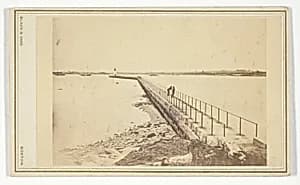
Goat Island, Lighthouse
1864/67
Medium
Albumen print
Dimensions
Image: 5.4 × 7.7 cm (2 3/16 × 3 1/16 in.); Card: 6.1 × 10.1 cm (2 7/16 × 4 in.)
Classification
photographic process
Department
Photography and Media
Museum
Art Institute of Chicago
Accession Number
33496
Rights
Public Domain
Art Historical Context
Nestled in the misty grandeur of Niagara Falls, *Goat Island, Lighthouse (1864/67) by the photography duo Black & Chase captures a serene yet dramatic view of this iconic American landmark. Goat Island, dividing the Niagara River's rapids between the U.S. and Canada was a prime vantage point for early photographers drawn to the Falls' raw power. Produced during the Civil War era, this intimate albumen print—measuring just 5.4 × 7.7 cm on a slightly larger card—served as a portable souvenir, evoking the era's booming tourism. The albumen printing process, introduced in the 1840s, revolutionized photography with its egg-white-based emulsion, yielding rich tones, fine detail, and a warm sheen ideal for landscapes. Black & Chase, active in the Niagara region, mastered this technique to document natural wonders, turning fleeting vistas into lasting keepsakes. Often mounted on cards like this one (6.1 × 10.1 cm), such prints fueled the carte-de-visite craze, making grand scenes accessible to middle-class collectors. Held in the Art Institute of Chicago's Photography and Media department, this work highlights photography's shift from novelty to art, preserving 19th-century America's awe-inspiring frontiers for generations. Imagine holding this tiny window to the past—Niagara's lighthouse standing sentinel amid thundering waters.